Test Automation Technical Essentials
Master advanced technical concepts and best practices to build efficient, maintainable, and scalable test automation solutions that drive quality in modern software development.
🎯 Learning Resources
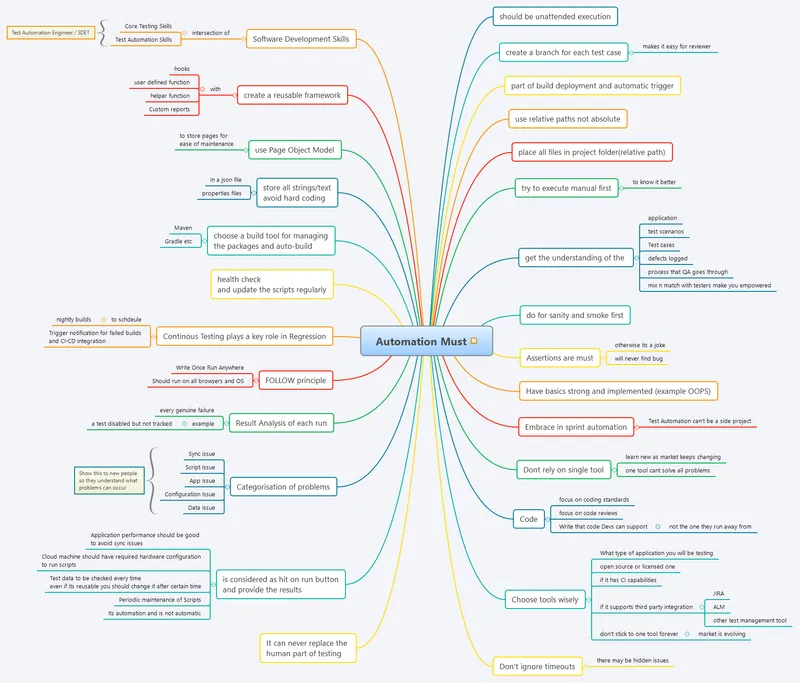
🚀 Execution Fundamentals
Unattended Execution
Automation should run completely unattended without human intervention. Design your tests to:
- Handle unexpected scenarios gracefully
- Run independently without external dependencies
- Provide clear, actionable results
Version Control Best Practices
- Create a branch for each test case - makes code review easier and maintains clean history
- Use meaningful commit messages
- Implement proper branching strategies (GitFlow, GitHub Flow)
CI/CD Integration
- Make automation part of build deployment pipeline
- Set up automatic triggers for different events (PR, merge, scheduled)
- Ensure fast feedback loops
📁 Project Structure & Organization
File Management
- Use relative paths, not absolute paths - ensures portability across environments
- Place all files in project folder using relative paths
- Organize test data, page objects, and utilities in logical folder structures
Prerequisites Understanding
Before automating, execute scenarios manually first to:
- Understand application behavior thoroughly
- Identify potential edge cases
- Build domain knowledge
Application Knowledge Requirements
Gain deep understanding of:
- Application architecture and user workflows
- Test scenarios and acceptance criteria
- Test cases and expected outcomes
- Defects logged and common failure patterns
- QA processes and team practices
- Collaboration with testers - leverage their domain expertise
🎯 Test Strategy & Prioritization
Start with Critical Paths
- Begin with sanity and smoke tests first
- Focus on high-impact, frequently-used features
- Build confidence before expanding coverage
Assertion Strategy
Assertions are mandatory - without them, tests are meaningless:
- Verify expected outcomes explicitly
- Use meaningful assertion messages
- Implement both positive and negative validations
- Test data integrity and business rules
💻 Technical Excellence
Programming Fundamentals
- Master programming basics (OOP principles, data structures)
- Focus on clean code practices
- Implement proper error handling
- Write code that developers can maintain and support
Sprint Integration
- Embrace in-sprint automation - it cannot be a side project
- Align automation with development cycles
- Participate in sprint planning and retrospectives
Tool Diversity
Don't rely on a single tool:
- Learn multiple tools as market evolves
- Understand that one tool cannot solve all problems
- Stay updated with emerging technologies
🛠️ Framework Design & Architecture
Reusable Framework Components
Build frameworks with:
- Hooks for setup and teardown
- User-defined functions for business logic
- Helper functions for common operations
- Custom reporting capabilities
Design Patterns
- Implement Page Object Model for maintainable page representations
- Use Factory patterns for test data creation
- Apply Singleton patterns for driver management
Configuration Management
- Store all strings/text in external files
- Avoid hard-coding values in test scripts
- Use JSON files or properties files for configuration
- Implement environment-specific configurations
🔧 Tool Selection & Build Management
Smart Tool Selection
Consider these factors:
- Application type you're testing (web, mobile, API)
- Open source vs licensed solutions
- CI/CD capabilities and integrations
- Third-party tool support (JIRA, ALM, test management tools)
- Team expertise and learning curve
Build Tools
Choose appropriate build tools:
- Maven for Java projects
- Gradle for flexible build automation
- npm/yarn for JavaScript/TypeScript projects
- pip for Python projects
⏱️ Performance & Reliability
Timeout Management
- Don't ignore timeouts - they may reveal hidden issues
- Implement smart wait strategies
- Use explicit waits over implicit waits
- Monitor and analyze timeout patterns
Health Monitoring
- Regular health checks and script updates
- Monitor test execution trends
- Implement alerting for consistent failures
🔄 Continuous Testing & Integration
Regression Strategy
Continuous testing is crucial for effective regression:
- Schedule nightly builds for comprehensive coverage
- Trigger notifications for failed builds
- Integrate with CI/CD pipelines
- Implement parallel execution for faster feedback
Core Principles
Follow these fundamental principles:
- Write Once, Run Anywhere (WORA)
- Cross-browser and cross-platform compatibility
- DRY (Don't Repeat Yourself) - eliminate code duplication
- SOLID principles in test design
📊 Analysis & Maintenance
Result Analysis
Analyze every test run systematically:
- Investigate every genuine failure
- Track disabled tests and their reasons
- Maintain test execution metrics
- Identify trends and patterns
Problem Categorization
Classify issues effectively:
- Synchronization issues - timing and wait problems
- Script issues - code defects or logic errors
- Application issues - genuine bugs found
- Configuration issues - environment or setup problems
- Data issues - test data corruption or unavailability
Train new team members on these categories for faster issue resolution.
🎯 Automation Realities & Expectations
Infrastructure Requirements
Ensure proper setup:
- Application performance should be optimized to avoid sync issues
- Cloud machines need adequate hardware configuration
- Test data requires periodic validation and refresh
- Regular script maintenance is essential
Key Understanding
Remember these critical points:
- Automation is not automatic - it requires ongoing maintenance
- Human oversight remains essential for quality assurance
- Test automation complements, never replaces exploratory and usability work
- Continuous learning and adaptation are necessary
🤝 Connect & Learn More
Ready to level up your automation skills? Let's connect and follow for more insights:
Building robust test automation requires both technical expertise and strategic thinking. Focus on creating maintainable, scalable solutions that provide genuine value to your development process.